
Protecting Plants from Cold Weather Damage
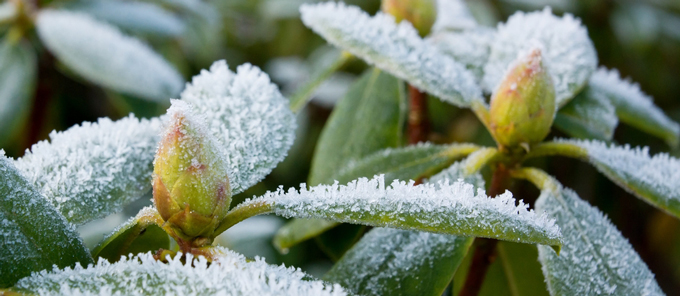
It is the beginning of a new year and there is some bitter cold headed our way. Northeast gardens have had mild temperatures all winter and many of us have noticed that spring bulbs and perennials have responded by emerging from the soil while shrub and tree buds have swollen. What, if anything, should be done to protect these plants from cold weather damage? Before we get to the answers let’s assume the following.
- The plants are native to the area, or at least hardy alternatives
- The plants are placed and planted correctly
- The plants have not been fertilized recently and were able to acclimate or “harden off”.
The landscape has seen its share of damage recently, with tornadoes, hurricanes, pre-season snowstorms, and more. It would be just heart-breaking to see more damage after repairing or replacing that already lost. When it comes to protecting ornamental plants from winter damage generally our first priority is structure. Will it break or fall down? Will the stem withstand strong wind, heavy snow, or accumulating ice (remember, we’re assuming they were planted correctly so we’re not including heaving from freezing and thawing)? Then, our concern turns to transpiration. Which plants are most prone to loss of water through natural processes?
Well, evergreen species—more specifically, broad-leaved evergreen species like Rhododendron sp.—quickly become top contenders for winter damage. In many cases these species have their own defense mechanisms to prevent water loss, but in situations where the ground is frozen and the air temperature is high enough to trick the plant into moving water from the roots to the stems and out of the leaves, there is a net loss of water. The result is often an exposed branch’s leaves looking like a cigar (rolled AND brown). What can be done? In many cases an anti-desiccant can be applied, but it is best not to rely on this remedy and it is not for all species. It is always better to site the plants in a place shaded from winter’s noonday sun, more than likely to the north of the house or other tall structure or planting.
It is NOT advisable to wrap a plant in plastic, canvas or other impermeable cover to keep it warm—at least here in the Northeast. In rare situations when there is a weak or poorly pruned specimen it may be appropriate to drape or wrap it in burlap or similar material; but only for the purpose of protecting against broken branches (think: structure). As soon as the danger has passed remove the wrapping. Leaving it on can cause conditions similar to that inside a greenhouse (warm, moist air), which would cause the plant to come out of dormancy prematurely. Some materials also can cause sun scald. And, they provide excellent shelter to creatures which feed on the very plants of concern.
As for bulbs and perennials we can quickly cover any exposed parts with leaves from yard. We don’t want to use any bark or wood mulches, composts or other material that are actively producing heat. Finished compost or bark mulches are fine, as are many other natural materials. Actually, snow is a great cover—if there is any nearby. Again, the idea is not to produce a situation where the plants are responding with premature growth. Just cover them to protect against cold winds and being trampled.
What happens to the plants that prematurely push out buds or emerge? In all likelihood there will be little damage. In the case of ornamentals it might be a less showy presentation of early spring flowers. If the existing buds survive the harsh cold there might be some visible “winter burn”. Some plants might respond with a second, smaller flush of flowers. In the end, spring will come and we will garden once again.